
Before discharge: practise
Ask a nurse to observe you emptying and changing the appliance. If vision, hand movement or reaching your abdomen is difficult, involve and train a helper.
Ileostomy & colostomy
From your first pouch change to eating and leaving home: clear advice for adults and carers, with product pictures, videos and an Egypt supplies directory.
This adult guide supports hands-on teaching. Your clinical team’s plan and your product instructions take priority; children need an individual plan.
Ask a nurse to observe you emptying and changing the appliance. If vision, hand movement or reaching your abdomen is difficult, involve and train a helper.
Know your stoma type, appliance codes, change schedule, food and fluid plan, follow-up date and out-of-hours contact. Record your individual instructions on the care card.
Check pouch fullness and the seal. Notice output, urine and any dizziness. Prepare supplies before a change, remeasure early on, and record leaks or irritation rather than putting up with them.
Reorder before the last pouch. Keep the packaging or a clear code photo, allow for delivery time, and check fit and compatibility before buying a large quantity of a new system.
MSK: caring for an ileostomy or colostomy · NHS: living with a colostomy · NHS: living with an ileostomy
It lets stool and gas leave your body into a pouch. A healthy stoma is pink or red and moist; the surrounding skin should look like the rest of your abdomen. Initial swelling gradually settles.
This depends on the operation, disease and whether the bowel can safely be reconnected. A loop stoma has two openings, sometimes only one visible. Appearance alone does not establish whether reversal is possible.
An ileostomy comes from the small bowel, often on the right; a colostomy comes from the colon and can be on either side. Confirm the type from your operation report.
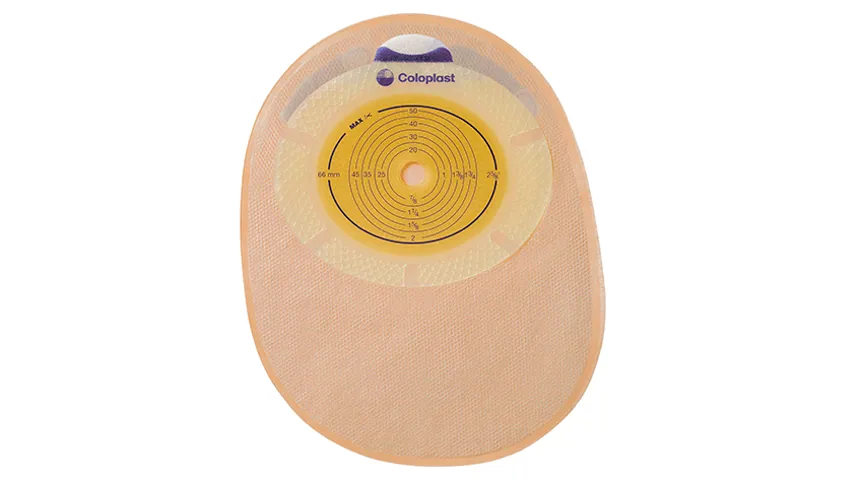
Barrier and pouch are one unit; may suit formed stool.
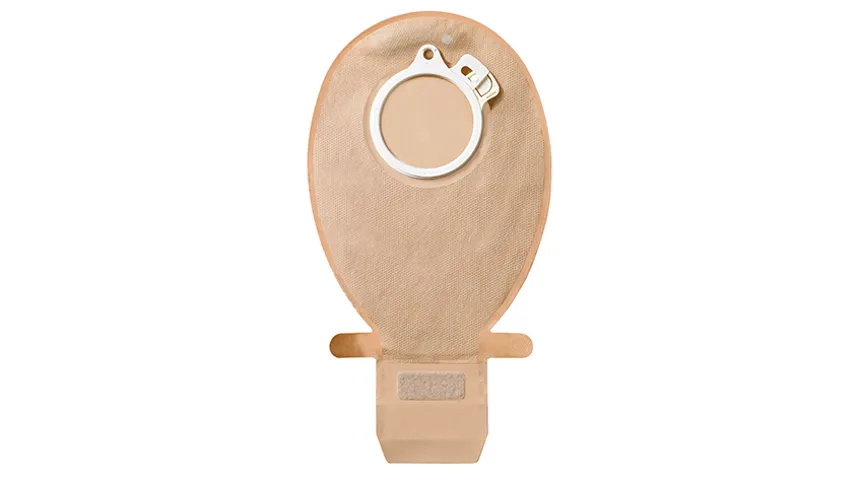
Empties through an outlet and needs a compatible separate barrier.
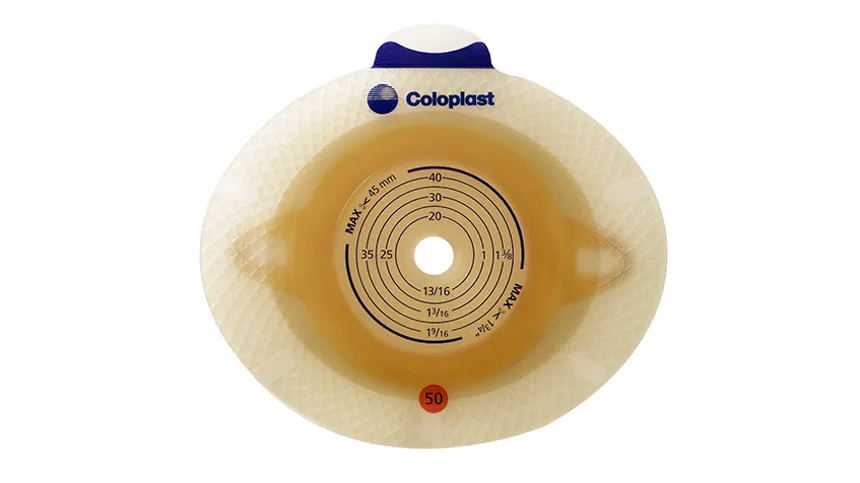
The stoma opening differs from the pouch coupling size.
Actual Coloplast product photographs to identify the parts; not a brand recommendation. Source
This adheres to and protects the skin. Its inner opening fits your stoma. A two-piece system also has a separate coupling that connects the pouch.
A one-piece pouch and barrier are removed together. A two-piece system may allow pouch replacement while a sound barrier remains, following its instructions. Neither design suits everyone.
Drainable pouches usually suit ileostomies and frequent or liquid stool. Closed pouches may suit formed colostomy output and are replaced after use. A tap-ended urinary pouch is not an automatic substitute for a stool pouch.
Convexity can help selected flush or retracted stomas, creases or leakage. A specialist should choose its depth and any belt, particularly soon after surgery. Do not add pressure yourself.
NHS: living with a colostomy · Coloplast Egypt: products and original product photographs
Rotate the model, look closer, or play the appliance-changing sequence. This model illustrates a two-piece system; your stoma and closure may look different.
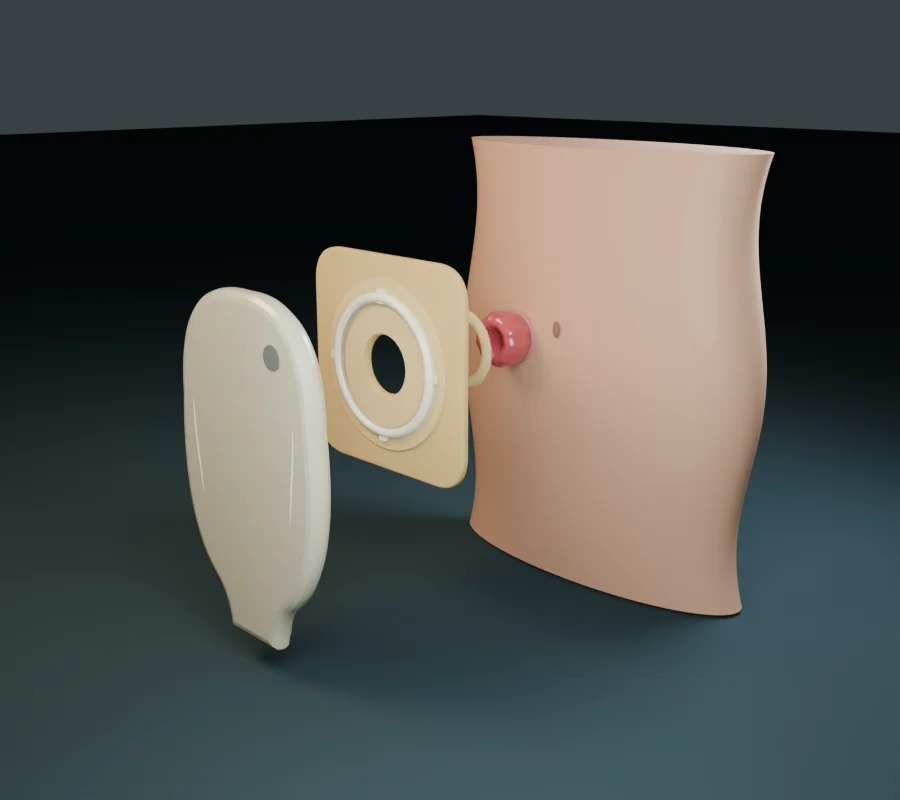
Preparing the 3D model…
Drag to rotate · Pinch to zoom
Have a compatible pouch and barrier, measuring guide, pen, curved scissors for cut-to-fit products, warm water, soft wipes and a disposal bag ready. Use only the accessories you need. Choose a quieter output period without deliberately skipping food or fluids.
Voice guide · advances after each step
A visual guide, not a simulation of every appliance. Cut the barrier away from your body. Use a protective ring only if needed.
Press Play guide to hear each step in order. Pause, resume or choose a step yourself. Dimensions and colours are illustrative, not a measuring tool or a way to identify stoma type. Written instructions are also available below.
A rendered 3D video showing the skin, optional ring, barrier and pouch. The motion explains how the layers fit together; follow the written steps and your appliance instructions when changing it.
Silent video · Press play to watch
Have a compatible pouch and barrier, measuring guide, pen, curved scissors for cut-to-fit products, warm water, soft wipes and a disposal bag ready. Use only the accessories you need. Choose a quieter output period without deliberately skipping food or fluids.
Empty a drainable pouch first. Support the skin with one hand and slowly peel the barrier away with the other. A medical adhesive remover can help. Avoid pulling the skin or using household solvents.
Use warm water and a soft cloth, then pat dry. Water is usually enough. If using mild oil-free, fragrance-free soap, rinse thoroughly. Inspect both the skin and the back of the old barrier for evidence of leakage.
Remeasure the stoma, especially during the first 6–8 weeks and after body changes. Follow the product guide for a close fit without pressure or unnecessary exposed skin. Cut away from your body and pouch, smoothing the edge. Do not cut mouldable products unless their instructions say to.
A ring or a small amount of paste can fill gaps as demonstrated. Let any liquid skin barrier dry completely. A light dusting of stoma powder is for moist, damaged skin, with excess removed and the cause assessed. Do not routinely layer every accessory.
Dry the skin, remove the backing and centre the opening. Gently press the adhesive around the stoma, then hold your palm over the barrier for about a minute or as instructed. Avoid pressure on the stoma itself and never use a hot hairdryer.
For two-piece systems, check coupling compatibility and attach using that product’s click or adhesive connection. Check the entire seal. Close the drainable outlet using the folds or clip specified by the manufacturer; designs differ.
Check the seal and outlet. There should be no pinching, pain or leakage. Put the used appliance in a sealed waste bag, never in the toilet. Wash your hands and note the change date and any problems.
Empty a drainable pouch at about one-third to half full and before bed or going out when needed. Ileostomies may need more frequent emptying.
Have tissue ready. Sit or stand comfortably over the toilet. Lift the tail before opening, then point down and release the contents gently. Clean and dry the inside and outside of the outlet, close according to its instructions and wash your hands.
You do not remove the barrier every time you empty the pouch. Do not wash closed disposable pouches for reuse, puncture a pouch to release gas, or insert objects into the stoma.
There is no universal number of days. Some systems last several days; closed pouches may need replacing more than once daily. Plan changes before adhesive erosion or leaks and respect the product’s maximum wear time.
Change promptly and inspect the skin. Do not wait for your usual day or tape over a stool leak. Seek same-day help if you cannot obtain a reliable seal.
Measure at each early change until size settles, and after weight changes or a new bulge. Keep your product code, packaging photograph and measuring template.
Three English-language videos from Memorial Sloan Kettering, with written summaries. These are not Dr. Fady’s videos; the appliances may differ from yours.
Watch preparation, gentle removal, cleaning, measuring and application. Your wear-time plan and product instructions take priority.
Open original videoShows one hook-and-loop outlet. The closure method and fold count may differ for your pouch.
Open original videoPowder and barrier technique when needed and as taught. Stop powder after healing and seek review for ongoing irritation.
Open original videoThe external player loads only when selected. Use the original link if it cannot play here.
Leakage, moisture and repeated pulling can damage skin. Clean gently and dry thoroughly. Avoid scrubbing the stoma or shaving close to it with a razor; ask how to trim hair safely if it affects adhesion.
Do not routinely use alcohol, iodine, peroxide, harsh antiseptics, perfume, oils, petroleum jelly or greasy creams under the barrier. Baby powder is not stoma powder. Steroids or antifungals need a diagnosis and an adhesive-compatible preparation.
Use a light layer on moist damaged skin only when advised, remove excess, and stop once healed. A liquid barrier may be used over it as taught and allowed to dry. Widespread rash, ulcers or pus need assessment.
Adhesive remover helps release the old appliance. Skin barrier film protects skin before application. They serve different purposes; excess layers can reduce adherence.
UOAA: healthy skin around a stoma · Hollister: accessories and their uses
Choose accessories for a specific need after correcting fit. Examples identify names, not prescriptions or commercial preferences; an international product name does not prove local availability.
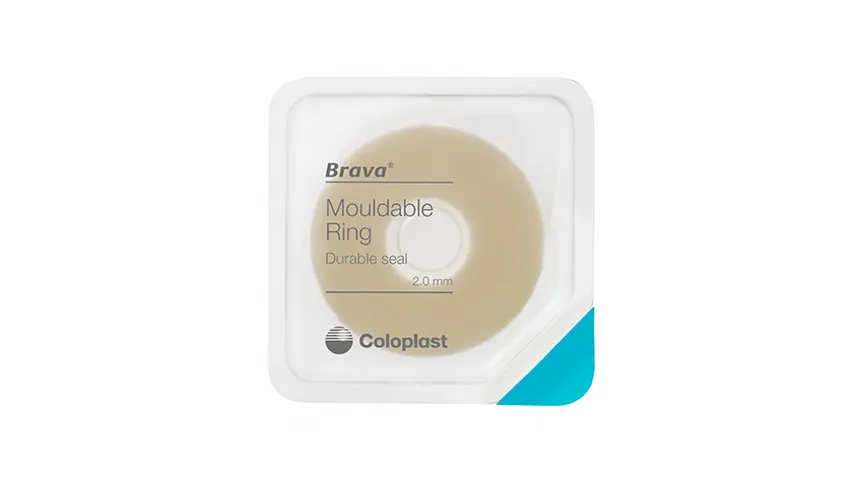
For filling gaps and improving the seal when needed.
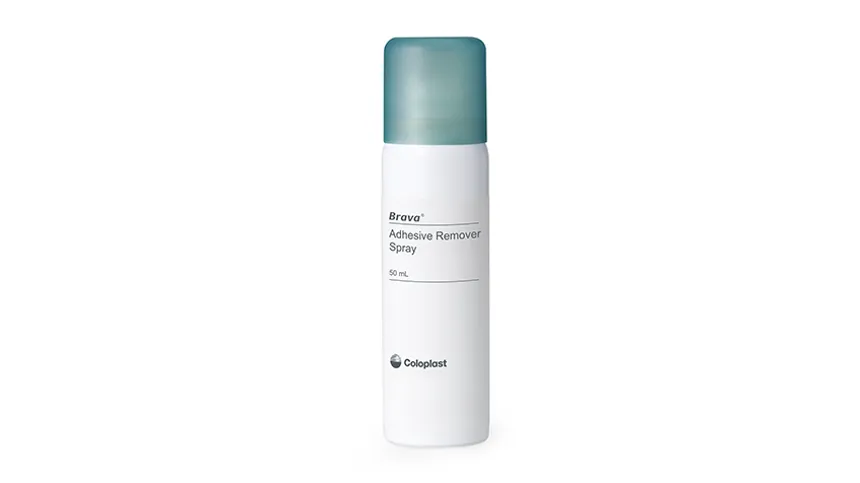
Helps release the old barrier gently.
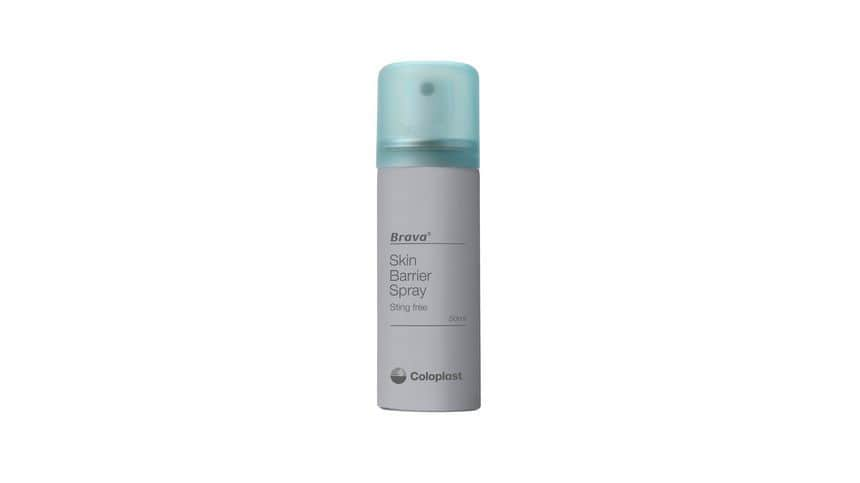
A protective film allowed to dry before fitting, when needed.
| Type | Use and caution | Example names |
|---|---|---|
| Barrier ring | Fills gaps and folds when needed; different from the plastic coupling ring. | Brava Mouldable Ring · Hollister Adapt |
| Stoma paste | Small amounts fill uneven areas. It is not glue or a treatment cream; some formulas sting damaged skin. | Brava Paste · Stomahesive · Medi Stomy Paste |
| Stoma powder | For moist damaged skin as advised. Brush off excess and stop when healed. | Brava Powder · Stomahesive Powder · Adapt Powder |
| Medical adhesive remover | For removal; follow its cleansing and drying instructions. | Brava Adhesive Remover · ESENTA / Sensi-Care Adhesive Remover |
| Skin barrier film | No-sting spray or wipes when indicated; check barrier compatibility and let dry. | Brava Skin Barrier · ESENTA / Sensi-Care Skin Barrier |
| Extenders, belt, deodorant | Extenders support intact edges, never cover a leak underneath. Fit belts properly; pouch deodorants go inside the pouch only. | Brava · Adapt |
Ask the supplier to confirm actual stock and codes for powders, rings and sprays. The Brava 10×10 protective sheet was listed out of stock when checked; do not rely on it as an available substitute.
Hollister: accessories and their uses · Coloplast Egypt: products and original product photographs
Follow your discharge plan. Small easy-to-digest, temporarily lower-fibre meals are commonly advised. Chew well and reintroduce foods gradually. There is no permanent banned-food list for everyone.
Coarse foods such as popcorn, corn, nuts, skins and stringy vegetables can trouble some people or contribute to blockage, especially early on or with narrowing. Introduce cautiously as advised and chew thoroughly. Monitor output and urine.
After recovery, a balanced diet and gradual fibre reintroduction are often possible. For constipation, review fluids, food and movement with your team. Do not take laxatives if there is pain, vomiting or possible obstruction.
Record your own triggers rather than excluding whole food groups. Fizzy drinks, fast eating, gum and beans can increase gas for some people. Persistent odour from a closed appliance calls for a seal check; odour during emptying is expected.
Discuss fasting beforehand, particularly with an ileostomy, diabetes or kidney disease. Do not deliberately reduce fluids to reduce emptying. Heart or kidney disease and other restrictions require a personal fluid and salt plan.
Cambridge University Hospitals: colostomy nutrition · Cambridge University Hospitals: ileostomy nutrition
Output is usually softer and more frequent than with a colostomy. Early on, or when output changes, measure a 24-hour total in a graduated jug and record fluids and urine as instructed. Pouch size is not an accurate volume measure.
Ask for advice if output becomes markedly watery, rises above your usual level or exceeds roughly 1–1.5 litres in 24 hours, especially after recent surgery. Follow your hospital’s individual threshold; do not wait to reach a number if symptoms develop.
Less or darker urine, marked thirst, dry mouth, dizziness, weakness or cramps need attention. Fainting, severe drowsiness or inability to drink needs emergency care. High-output colostomies can also cause dehydration.
High output may require a prescribed oral rehydration plan, salt adjustments, blood tests or intravenous fluids. Do not simply drink several extra litres of plain water. Do not start fluid restriction, homemade salt recipes or loperamide doses yourself. Sports drinks are not equivalent to every medical rehydration solution.
Go to the nearest emergency department. Do not wait for a clinic reply or try a new product first.
NHS: colostomy complications · NHS: ileostomy complications · MSK: ileostomy diet and blockage symptoms
These are action guides, not a diagnosis. Seek help immediately for rapid deterioration or a warning sign even if your problem is not listed.
Change it and inspect the skin and back of the barrier. Clean and dry gently, then check fit and creases. Do not tape over a stool leak.
Contact the stoma team today if leakage continues or you cannot protect the skin.
Read moreFit, leakage, moisture or pulling may contribute; redness alone does not identify the cause. Avoid adding random creams or medicines.
Severe pain, pus, spreading redness or fever needs urgent assessment. Deep ulcers or loss of the seal need specialist help.
Read moreNew pain, cramps, nausea or swelling needs urgent contact. Severe pain or repeated vomiting needs emergency care. Do not wait for a time threshold if symptoms occur.
Do not insert tools, a finger or water into the stoma, or self-treat possible obstruction with laxatives or irrigation.
Read moreRecord 24-hour output, urine and symptoms if possible without delaying help. Follow your written rehydration plan.
Fainting, marked drowsiness, very little urine or inability to keep fluids down needs emergency care. Do not increase anti-diarrhoeal doses yourself.
Read moreA few spots during cleaning can occur. Avoid rubbing; use clean gauze with gentle pressure. Recurrent bleeding or bleeding from inside the opening needs medical advice.
Heavy bleeding, bleeding that does not stop, or dizziness with bleeding needs immediate emergency care. Do not assume blood in the pouch is normal.
Read moreA shape change needs assessment and possibly a different fit. Do not force the stoma back in or add a tight belt yourself.
A newly black, blue or markedly dark stoma, or a bulge with severe pain or vomiting, needs emergency care.
Read moreWOCN — skin assessment · NHS — colostomy complications · NHS — ileostomy complications
Change the system and check size, dry skin, folds and the direction of stool flow. Ask for a fitting review rather than changing many brands and accessories at once.
Check the filter and follow your pouch’s gas-release instructions. Never puncture it. Cover the filter for bathing only if the manufacturer says to.
Thick stool and pouch walls sticking together can cause pancaking. Ask about a pouch lubricant and filter suitability. Do not put household oils on the adhesive.
The stoma has a rich blood supply. Be gentle. Persistent bleeding despite gentle pressure with clean gauze, heavy bleeding or blood coming from inside the stoma needs urgent assessment. Blood in the pouch should not be dismissed.
A changing stoma length or a bulge needs review and possibly a different appliance. Severe pain, colour change, vomiting or stopped output needs emergency assessment; do not push it back forcefully.
If your rectum remains, it may still produce mucus despite stool diversion. You can sit on the toilet without straining. Pain, pus, bleeding or a change in discharge needs review.
Once your team allows it and wounds permit, showering with or without a pouch is usually possible. Pouches resist water; dry the adhesive area. Swim after healing and clearance with a secure seal. Do not direct a forceful jet into the stoma.
Avoid direct pressure on the stoma. Empty before sleep and find a comfortable position. Overnight emptying may be needed, especially with a new ileostomy.
Start with walking and increase gradually. Return to lifting, exercise and manual work with your surgeon’s guidance. A correctly fitted hernia support garment does not cure a hernia or guarantee prevention.
After recovery and medical clearance, a stoma need not prevent closeness or sexual activity. Empty the pouch and avoid pressure. Discuss pain, erection difficulties or dryness. Plan pregnancy around the underlying disease, surgery and medicines.
Carry at least two spare changes, underwear, waste bags and your template. Bring extra supplies for longer trips and keep some in hand luggage. Follow storage instructions and avoid a hot car or damp conditions.
Initial anxiety or embarrassment is understandable. Ask for repeated teaching for you and your carer. If worry stops you eating, sleeping or leaving home, seek support. Practice and follow-up help people return to an active life.
MSK: caring for an ileostomy or colostomy · NHS: living with a colostomy · NHS: living with an ileostomy
Tell your pharmacist and doctor your stoma type and known bowel resection. Some extended-release medicines may not be absorbed well, particularly with an ileostomy. Report tablets seen in the pouch; never crush or stop medicines yourself.
This is not routine washing for every stoma. It is suitable for selected left-sided colostomies only after specialist assessment and training. Never irrigate an ileostomy or insert a tube, enema or suppository yourself.
Reconnection depends on the disease, healing, remaining bowel and fitness for surgery, sometimes with further tests. “Temporary” does not promise a particular reversal date.
Ask for the operation name, a hands-on appliance demonstration, product codes and sizes, food/fluid/medicine plans, follow-up and urgent contact details. Take enough supplies to cover your first review and order.
MSK: caring for an ileostomy or colostomy · UOAA: colostomy irrigation
Verified listings are below, not a guaranteed census of every brand or size. Stock and prices change: contact the seller before travelling or paying. A listing is evidence of an offer, not a quality or stock guarantee.
EGMED lists Alterna; Coloplast Egypt lists SenSura and Brava accessories. Confirm the exact system, size and code; not every model is guaranteed.
EGMED pouch and barrier listings
Egypt catalogue and accessoriesPouches and barriers include systems such as Natura / SUR-FIT Natura, plus Stomahesive paste. Confirm family and code, not only coupling diameter.
Company office detailsBags, barriers and paste listed by Egy Health. Ask for the packaging, code and instructions to confirm stool use and compatibility; do not rely on a generic listing description.
Premier, New Image and Adapt products appear on import-to-Egypt marketplaces. Confirm source, delivery, landed cost and returns; do not depend on them for urgent supplies.
Example import listingOther international brands such as B. Braun, Dansac, Salts and Welland: a reliable Egyptian sales channel was not verified in this review, so they are not presented as locally available. Ask your team to check the box and code before switching.
11 Ebad El Rahman St, Sheraton, Heliopolis, Cairo.
Store contact page and map22 Kamal El Din Hussein St, 3rd floor, Sheraton, Heliopolis. Ask the office for a supplier; direct retail sales are not confirmed.
Company details69 Al Qasr Al Aini St, above Abu Shakra, Cairo, as listed by the retailer. Confirm product, stock and address before visiting.
Pouches and accessoriesTake the old packaging or code to the supplier. Accessories may be used across systems when their instructions allow, but two-piece pouches and barriers are not arbitrarily interchangeable. Ask your insurer or treating hospital about any coverage; it is not guaranteed.
A printable sheet to complete with your clinician or stoma nurse: stoma type, pouch and barrier codes, opening and coupling sizes, accessories, fluid plan and help contacts.
Open the card to print or save as PDFThe card is blank for completion on paper; it does not submit patient information to the website.
Usually yes. Alternatives are for selected colostomy patients after specialist teaching. Do not plug the stoma or cover it with gauze alone yourself.
Hand washing before and after is essential. Gloves can help carers or avoid contact with stool; routine self-care usually needs clean supplies rather than a sterile operating-room setting.
No. The brand, product family, coupling design and compatible codes must match. Coupling diameter and your measured stoma opening are different measurements.
An opening that is too tight or forceful removal can injure it. Too large an opening exposes skin to stool. Ask for a fitting review if there is pain, leakage or shape change.
Stopped output with cramps, swelling, nausea or vomiting needs urgent assessment even before several hours have passed. If output stops for about 4–6 hours, contact your team promptly. Do not take laxatives or insert anything.
Patterns depend on the bowel segment and diet; do not automatically apply ileostomy timings. Contact your team for a longer-than-usual gap, urgently if pain, vomiting or distension develops.
Start with the amount agreed with your team until fit and skin tolerance are established; the stoma changes after surgery. Keep a reserve and reorder before supplies run out.
No. A well-fitted appliance on clean dry skin may be enough. Accessories solve specific problems; more products do not necessarily mean better protection.
Have your operation name, last change, emptying frequency or 24-hour volume, packaging/code and any pain, fever or leakage details ready. Share clinical photos privately with your team when requested, not in public comments.
WhatsApp is for follow-up and coordination, not emergency care.
This reference is for adults with an ileostomy or colostomy and their carers. Discharge instructions, your care plan and appliance instructions take priority. Children, short bowel, pregnancy and fluid restrictions need individual plans. Share the guide or a specific section with your treating clinician.
The guidance draws on the named patient-education and specialist sources. Sources checked: 3 October 2026. Contacts and commercial stock can change; confirm before buying. The guide alone cannot diagnose complications or prescribe medication.
Patient-friendly guidance informed by the sources below. Original product photographs are from Coloplast Egypt; videos are embedded from MSK with source links. Brand names aid identification and compatibility, not seller endorsement or outcome guarantees. Prices are not fixed and the directory does not claim a complete census of Egypt’s market.